Generate PDFs with Cursor and PDFBolt
Connect Cursor Agent to PDFBolt to generate PDFs from prompts, web page URLs, or reusable templates.
PDFBolt hosts the MCP server, so you do not need to run one locally or provide a PDFBolt API key. Connect by signing in to your PDFBolt account through OAuth.
Before You Start
You need a PDFBolt account and the Cursor desktop app installed and signed in.
1. Add the PDFBolt MCP Server
Select Add to Cursor and allow your browser to open Cursor.

In the Install MCP server? dialog, review the configuration and select Install.
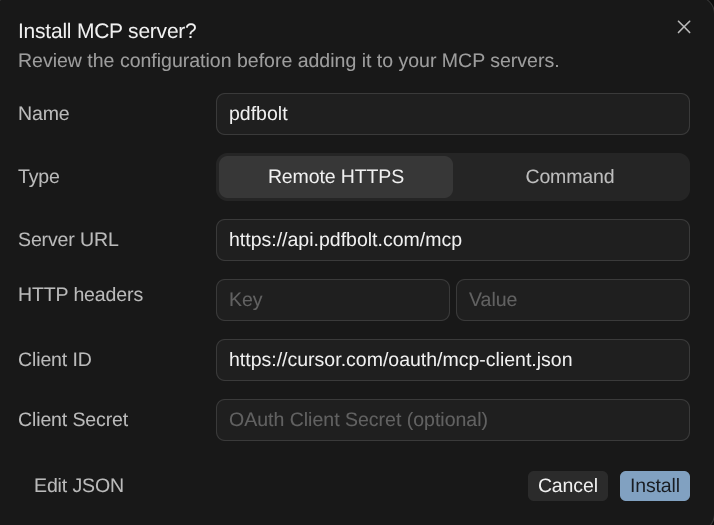
Alternatively, open Customize MCPs New MCP Server to open ~/.cursor/mcp.json. Add the configuration below, keeping any existing entries inside mcpServers, then save the file.
{
  "mcpServers": {
    "pdfbolt": {
      "url": "https://api.pdfbolt.com/mcp",
      "auth": {
        "CLIENT_ID": "https://cursor.com/oauth/mcp-client.json"
      }
    }
  }
}
This makes PDFBolt available across your projects. The CLIENT_ID value identifies Cursor for OAuth sign-in.
See the Cursor MCP documentation for other configuration options.
2. Sign In and Allow Access
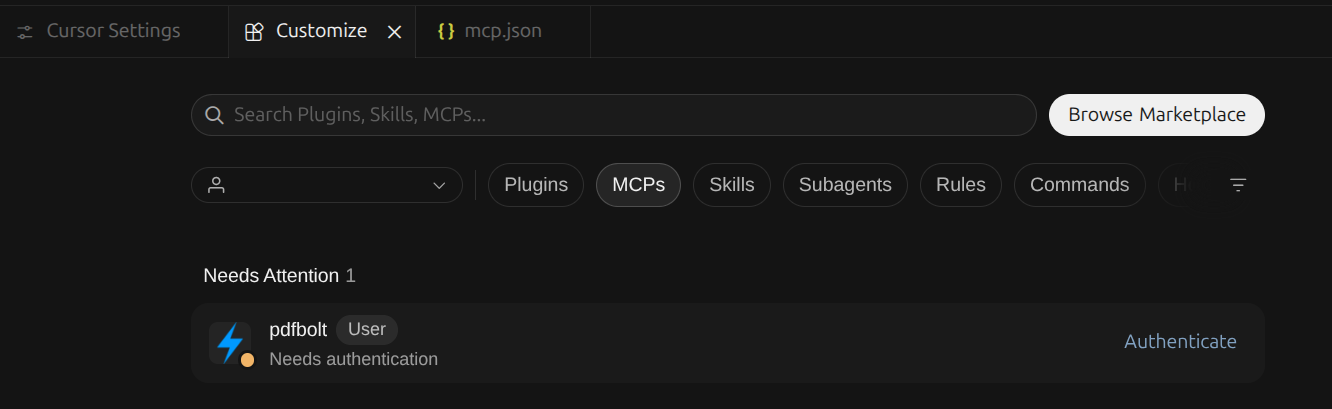
Go to Customize MCPs and select Authenticate next to PDFBolt.
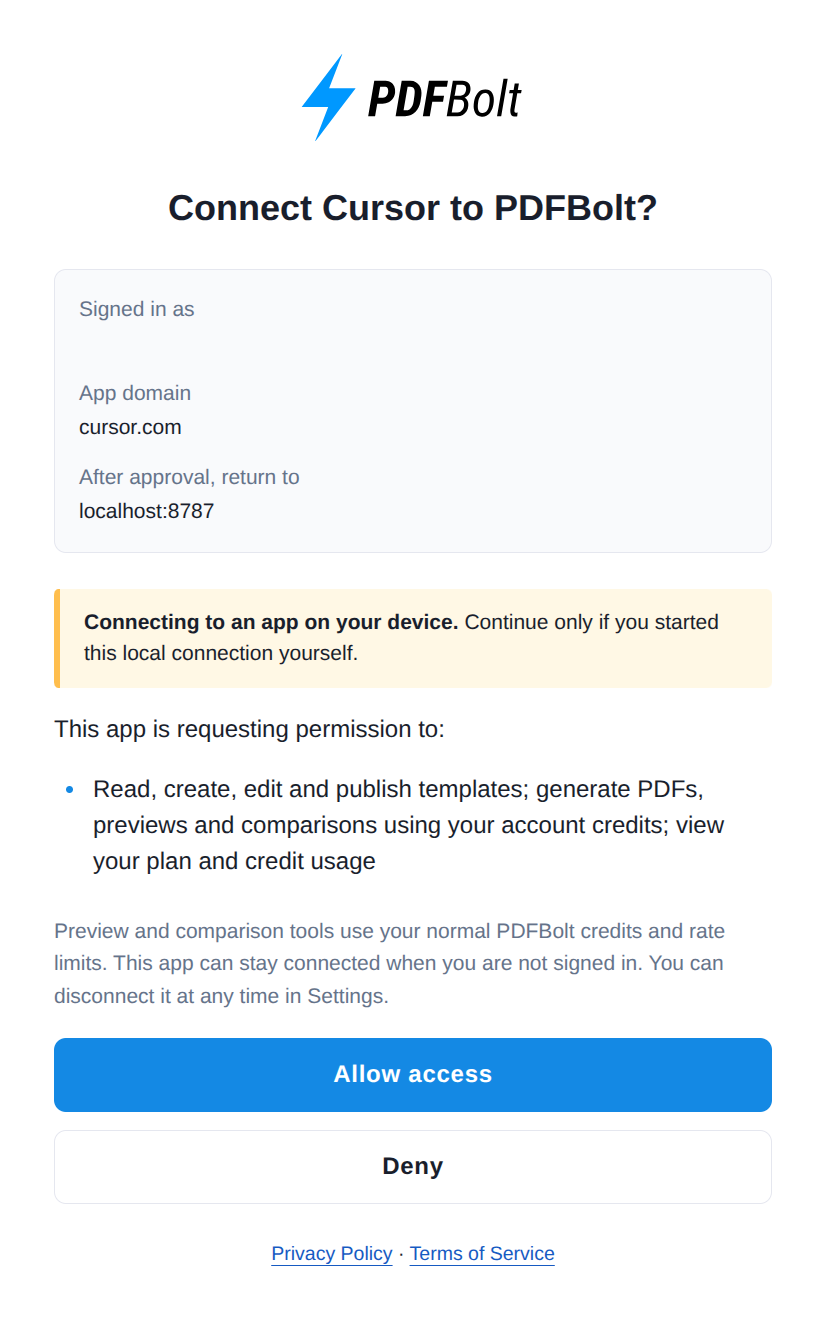
Sign in to PDFBolt if prompted. On Connect Cursor to PDFBolt?, review the permissions and select Allow access. These permissions cover PDF generation, template management, and access to your plan and credit usage. Return to Cursor after authorization.
3. Check the Connection
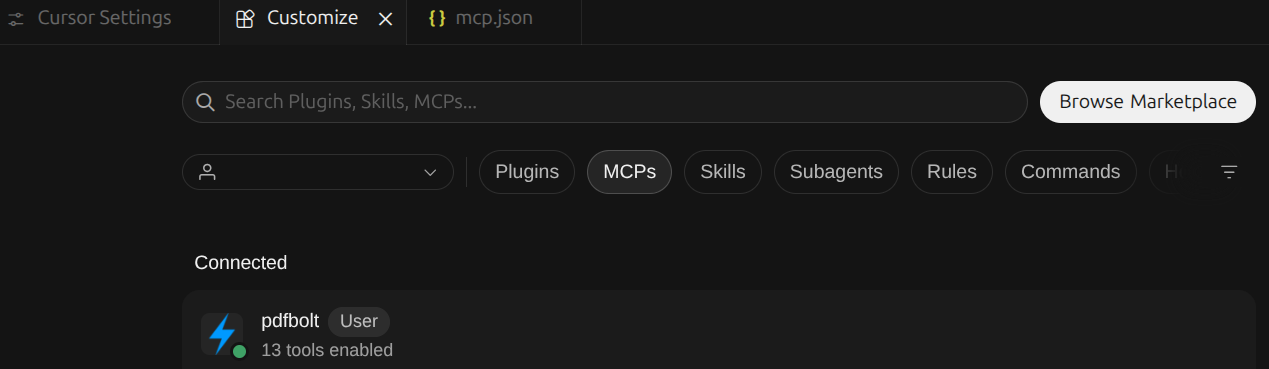
Go to Customize MCPs and check that pdfbolt appears under Connected.
Open an Agent conversation and send:
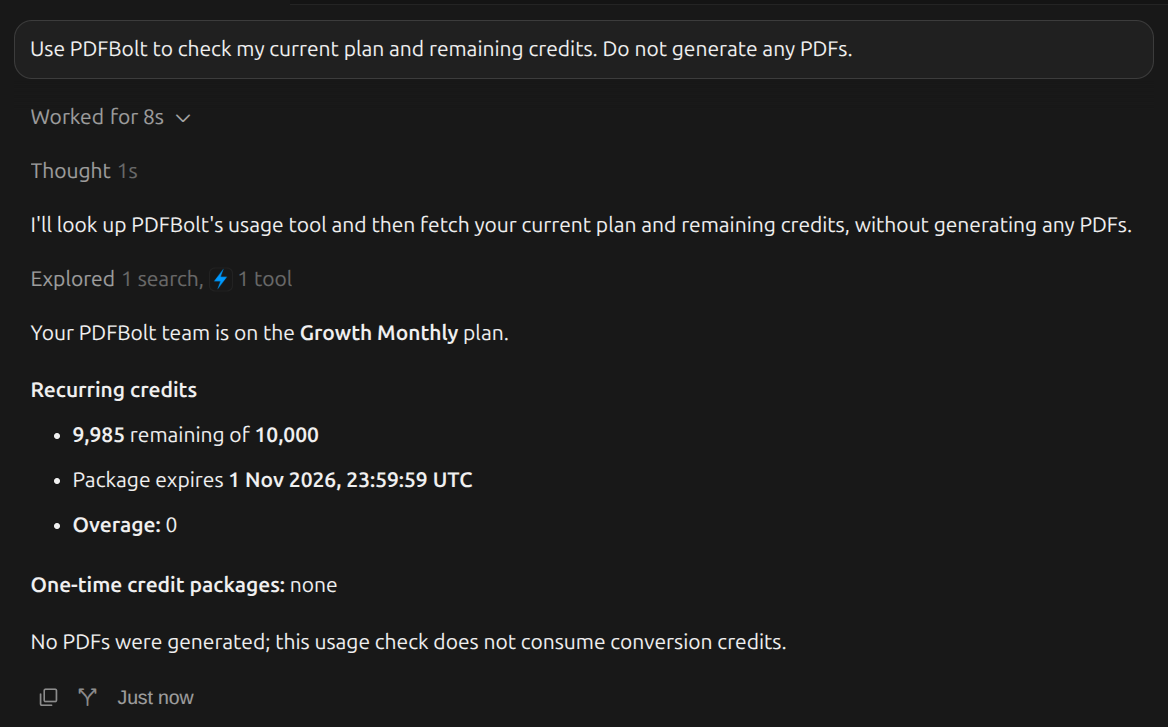
Use PDFBolt to check my current plan and remaining credits. Do not generate any PDFs.
Approve the tool request if Cursor asks. The response should include your PDFBolt plan and remaining credits. Checking usage does not consume PDF generation credits.
4. Generate a PDF from a Prompt
Describe the document you want to create, including its content and layout. For example:
Use PDFBolt to create a one-page A4 quote for Acme Studio: website design for $600 and development for $900. Show the total of $1,500. Use a navy heading and a clear pricing table. Give me a PDF download link without saving a template.
Cursor prepares the HTML and calls PDFBolt for HTML-to-PDF conversion.
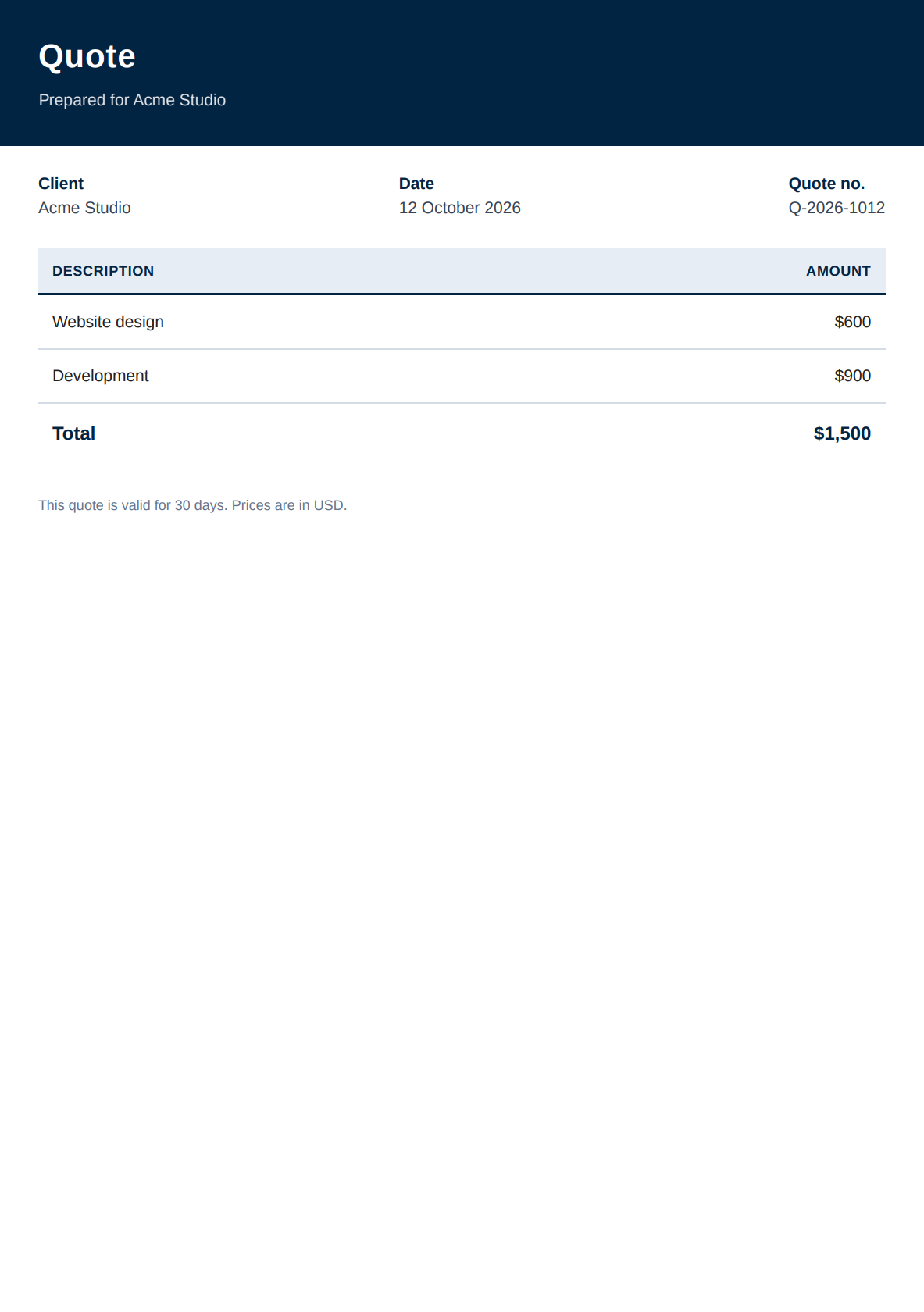
Open the download link in the response to view the document. The layout may differ from this example.
Troubleshooting
Cursor reports an incompatible auth server
If you see Incompatible auth server: does not support dynamic client registration, check that your pdfbolt configuration includes the auth.CLIENT_ID value shown in Add the PDFBolt MCP Server. Save the file, reload the server in Cursor, and select Authenticate.
Cursor cannot find PDFBolt's tools
Check that PDFBolt is connected and enabled under Customize MCPs. If the server shows an error, select Show Output for connection details.
If PDFBolt is missing, check your configuration against Add the PDFBolt MCP Server, save the file, and restart Cursor. If pdfbolt is configured in both .cursor/mcp.json and ~/.cursor/mcp.json, the project configuration takes priority.
Use an Agent conversation and mention PDFBolt in your prompt.
Cursor says the PDF is attached, but no file appears
A PDF returned in a tool response may not appear as a downloadable attachment in Cursor. If the response includes a download link, open it in your browser.
If there is no link, ask Cursor to provide one. Generating the PDF again to return a download link uses additional PDFBolt credits.
For other errors, see the MCP troubleshooting guide.
Related Documentation
📄️ PDF Layout Options
Adjust page size, margins, orientation, headers, and footers.
📄️ PDF Templates
Build reusable document layouts and fill them with your data.
📄️ Template API
Manage templates through the REST API.